Places of interest
What to visit?
Halfway between the sea and the mountains and within easy reach of Barcelona and Girona, the Osona region offers a wide variety of attractions to explore.
It is a land of contrasts and beautiful landscapes, including Montseny Natural Park, the Sau-Collsacabra Valley, with its impressive cliffs, the Ter landscapes, the Romanesque architecture of Lluçanès, and Vic, the capital of the region.
It is also a region renowned for its gastronomy and excellent local produce, as well as for its traditional festivals, fairs and markets.
Osona is therefore a place where every visitor can find something to enjoy and discover in a truly unique territory.
For more information
List of places of interest
El Bisaura
The Bisaura area encompasses the municipalities located in the northernmost part of the Osona region and stands out for its exceptionally beautiful landscapes.
The value of its landscape has led many areas of the Bisaura municipalities to become part of the Natural Area of Interest of the Milany-Santa Magdalena and Puigsacalm-Bellmunt mountain ranges.
If you visit the area, you should not miss the beautiful village of Vidrà, the Natural Area of Interest of Montesquiu Castle Park, the Sanctuary of Mare de Déu de Bellmunt, an excellent and privileged viewpoint over the region, and Salt del Mir in Santa Maria de Besora, where water falls from a height of 30 metres through a landscape surrounded by stone walls.
More information can be found at www.paisatgesdelter.com.
El Lluçanès
Distance 34 km. | Time 50 min.
A visit to Lluçanès offers the opportunity to discover small chapels and hermitages, including Santa Maria de Lluçà and the collection of Baroque altarpieces in Sant Boi de Lluçanès.
We also recommend visiting the Sanctuary of Mare de Déu dels Munts, located at an altitude of 1,000 metres and offering a fantastic viewpoint over Lluçanès.
The area also offers a range of natural spaces around streams such as the Merlès and Gavarresa, where you can enjoy charming corners, springs and natural pools.
In Sant Feliu Sasserra, you will find the Witches’ Interpretation Centre, which tells the story of the tragic events that took place in the 17th century.
El Moianès - L'Estany - The Toll Caves
Distance 17Km. | Time 25 min.
Moianès is a subregion of the Catalan Central Plateau. A traditional destination for hiking, it has a network of signposted paths, such as the Ronda del Moianès, a magnificent circular route that can be completed on foot or by bicycle.
The Monastery of l’Estany was founded in 1080. It consists of a group of buildings, including the Church of Santa Maria and a series of rooms used as a museum, surrounding a jewel of Catalan Romanesque architecture.
Its extraordinary interest lies in the 72 capitals of the complex, magnificently carved and remarkably well preserved.
The Toll Caves are one of the important prehistoric sites in Catalonia. They form a network of cavities almost two kilometres long, parts of which were inhabited by animals and humans from at least one hundred thousand years ago.
The Cliffs of Tavertet
Distance 37Km. | Time 1h.
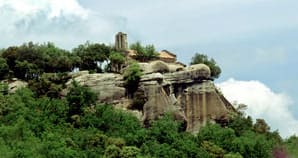
The cliffs define the unmistakable character of Collsacabra, and Tavertet is its most representative setting.
Perched above an enormous 200-metre-high cliff overlooking the Ter valley, this isolated location has retained its charm.
The village, declared a Site of Cultural Interest, preserves 48 houses built between the 17th and 18th centuries surrounding the Romanesque church of Sant Cristòfol, documented since the 11th century.
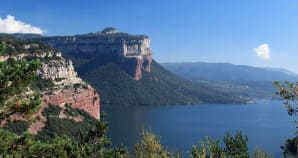
Facing this harmonious ensemble, the Tavertet cliffs plunge dramatically into the landscape, creating a striking contrast of colours and a breathtaking panorama: in the distance, Montseny and Matagalls; below, dense forests and vegetation and the Sau reservoir.
The cliffs, caves and rock shelters, together with the rivers and streams, add further richness to the landscape. Notable sites include Puig de la Força, which overlooks the valley; the Miradora cliff; Salt de l’Avenc, with a drop of more than 200 metres into the valley; and Salt del Molí Bernat.
The Hermitage of Sant Sebastià
Distance 15Km. | Time 20 min.
It is believed to have been built in response to the outbreaks of plague that devastated these territories at the beginning of the 16th century.
It is an excellent viewpoint overlooking the Plana de Vic and, beyond it, towards Collsacabra and, of course, Montseny.
On the Sunday after Easter, the traditional gathering takes place at the Hermitage of Sant Sebastià, where the caramellaires of Santa Eulàlia return to sing and perform the traditional dances of Easter Sunday.
The chapel’s great historical significance dates, however, from 17 May 1705, when the well-known Pact of the Vigatans was signed.
The pact was sealed by the leaders of Vic, who were given authority to sign an alliance treaty with England. The English would provide military assistance against Philip V of Castile and pledged to respect Charles III and Catalan laws. The victory of Philip of Bourbon in the War of the Spanish Succession marked the end of the rights and privileges of the kingdoms of the Crown of Aragon.
Les Guilleries - Savassona
The subregion of Les Guilleries lies to the east of Osona, forming a link between Collsacabra and Montseny.
Historically, it has been a sparsely populated and heavily forested area, giving these lands a certain legendary and mysterious atmosphere associated with banditry and witchcraft.
Les Guilleries is a rugged low-mountain landscape covered by extensive forests and small settlements.
The predominant forests are holm oak, oak and beech. There are also chestnut plantations. Viladrau is known for its chestnuts, while Espinelves is known for its pine and fir plantations and its popular Christmas fir fair held in December.
Ter Landscapes
Distance 18 km. | Time 25 min.
The Osona region is crossed by the middle course of the Ter River, which has shaped both its natural and historical landscape.
Throughout Osona, the Ter forms up to 19 meanders in just over 25 km. These meanders are pronounced curves in the river’s course. One of them surrounds Sant Pere de Casserres.
Over time, the river has shaped a landscape of natural weirs, mills, canals, textile factories, industrial colonies, bridges, dams and reservoirs, making the river an important source of wealth for the region.
The GR 210 path along the Ter and its network of trails follow the course of the river through the territory. (www.paisatgesdelter.com)
We recommend visiting the Ter Industrial Museum in Manlleu and the Borgonyà industrial colony in Sant Vicenç de Torelló.
The Gates of Montseny
Portes del Montseny is a territory located in the south of Osona and features a highly varied landscape. Montseny Natural Park, declared a UNESCO Biosphere Reserve, offers a remarkable diversity of landscapes.
The Romanesque heritage of these lands was among the earliest in Catalonia, with Sant Martí del Brull standing out in particular. In El Brull, you can also visit the Iberian fortification of Turó de Montgròs.
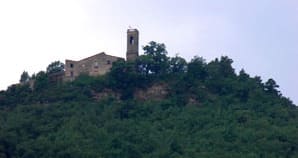
Some of the hills in this area are crowned by castles, including those of Centelles, Tona and Taradell.
Other places of interest include the Sanctuary of Mare de Déu de Puiglagulla, a southern viewpoint over Osona, and Puigsagordi, a popular destination for climbing enthusiasts, especially for the Baumes Corcades via ferrata.
Sant Pere de Casserres
Distance 29Km. | Time 45 min.
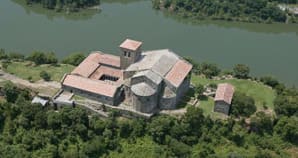
Located on a peninsula surrounded by a meander of the Ter River, the Casserres monastery is an ancient Benedictine monastic complex. After suffering significant deterioration over the years, successive restoration works have made it possible to explore the complete structure of the Romanesque monastery today.
Set in a truly unique environment beside the Sau reservoir, at the entrance to Les Guilleries, its different rooms transport visitors back to the monastic and medieval life of Osona.
Sau - Collsacabra
The power of nature is on full display in the Sau-Collsacabra Valley, creating a complex landscape: cliffs averaging 1,100 metres, the Sau reservoir and the humid forests of Les Guilleries form an ideal setting for outdoor activities.
The Sau reservoir, in Vilanova de Sau, is a paradise for water activities. Nearby, Tavertet and its cliffs bear witness to 5,000 years of history.
Rupit i Pruit form a single municipality in Osona and retain all the charm of their medieval character. Their architectural heritage takes you back in time through cobbled streets, rustic houses, Romanesque churches, the wooden bridge and the stone bridge of Can Badaire. If you visit Rupit, a visit to Salt del Sallent, with a drop of more than one hundred metres, is essential.
Salt del Cabrit and Salt de la Foradada, in the municipality of Santa Maria de Corcó-l’Esquirol, are also highly recommended.
Vic, capital of the region
Distance 9 km. | Time 15 min.
More than two thousand years of history have left the city with a rich heritage. The medieval centre preserves numerous examples of this heritage, and walking through its narrow, winding streets allows visitors to admire masterpieces from every architectural period.
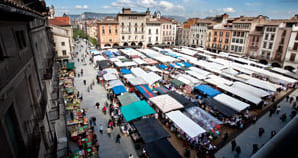
For many years, Tuesdays and Saturdays have been market days in the Plaça Major. We particularly recommend paying it a visit!
You should also not miss:
- The Cathedral, with Sert’s mural paintings
- The Roman Temple
- Queralt’s Romanesque bridge
- The walls of Pere III
- The Episcopal Museum, with its magnificent collection of medieval art
- L’Atlàntida, performing arts centre